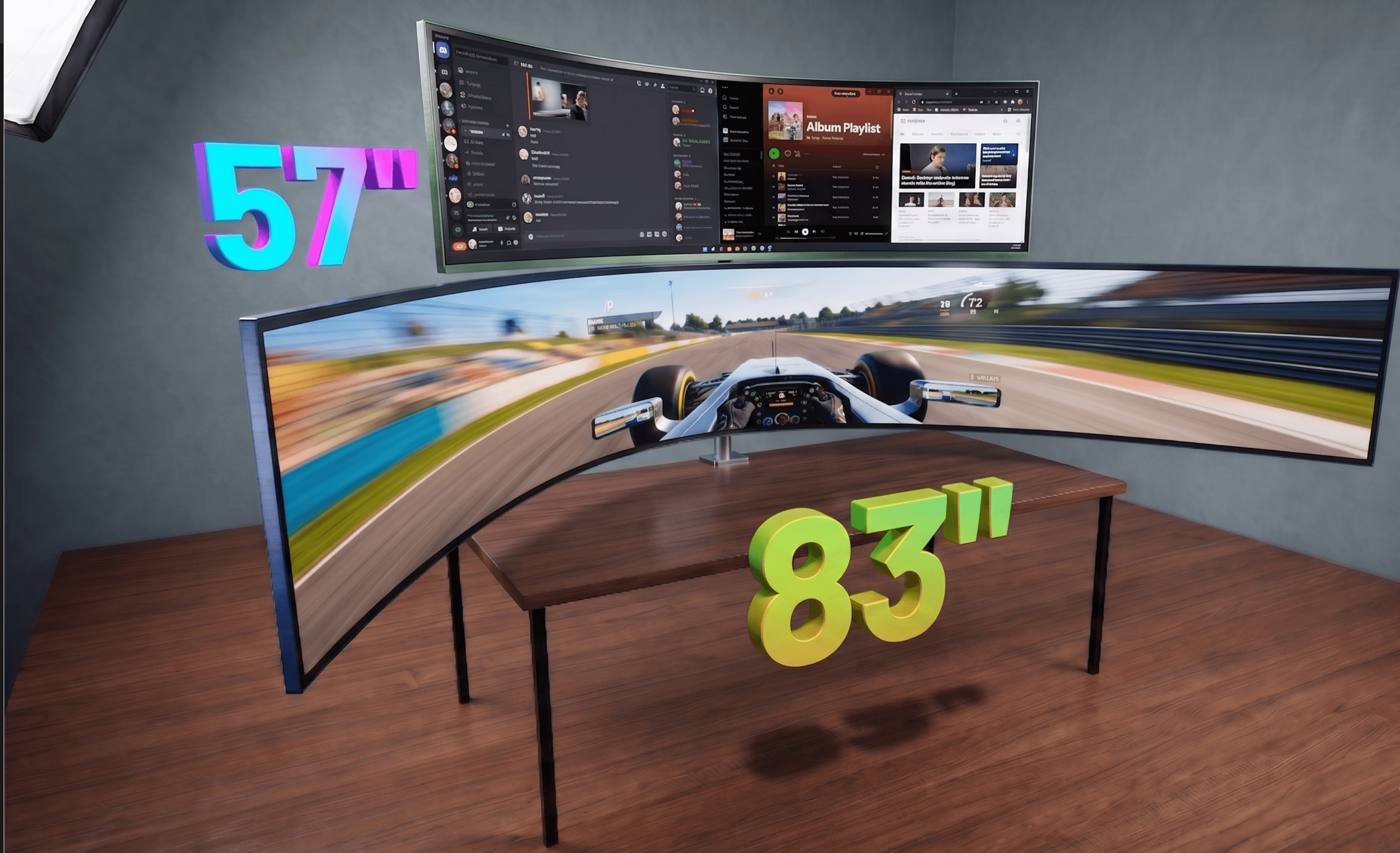
At Computex 2026, HKC pulled the covers off something that makes even today's biggest gaming displays look modest. The Shield C83U60 is an 83.4-inch curved super-ultrawide with a 48:9 aspect ratio and a claimed 12K resolution of 11,520 by 2,160. That works out to roughly 25 million pixels on a single sheet of glass, and HKC is aiming it squarely at people who are tired of bezels splitting their view.
It is, in the most literal sense, a triple-monitor rig folded into one panel. And while it is still very much a prototype, it is the clearest signal yet of where the high-end immersive display category is heading.
Three monitors, one panel
The math is what sells it. An 11,520 by 2,160 canvas is exactly three 3,840 by 2,160 displays lined up side by side. In other words, the Shield C83U60 carries the pixel count and physical footprint of three 32-inch 4K monitors, minus the two bezels that normally chop a multi-screen setup into thirds.
For anyone who has run a triple-monitor sim or trading setup, those bezels are the whole problem. They sit right where the action is, breaking immersion in a racing game and forcing you to mentally stitch spreadsheets back together across the seams. A single uninterrupted 48:9 surface removes that compromise entirely.
The R1000 curve, not 10,000R
HKC wraps the panel in an aggressive R1000 curve, pulling the far edges of that enormous screen toward you for a cocoon-like effect. If you have seen a video doing the rounds that quotes a 10,000R figure, that was an on-the-fly misread by the narrator. HKC's own materials confirm the curve is R1000, and at this width that tight radius is exactly what keeps the edges inside usable peripheral vision.
The 60Hz catch
There is a trade-off, and it is a big one: the Shield C83U60 tops out at 60Hz. Pushing nearly 25 million pixels is an enormous bandwidth ask, and driving that many pixels at higher refresh rates would demand display interfaces and GPUs that are only just arriving. Even at 60Hz, a panel like this will almost certainly lean on DisplayPort 2.1 or HDMI 2.1 with Display Stream Compression to feed it.
For sim racing and flight, where smoothness matters, 60Hz is the headline limitation. For financial multitasking, design work, and general immersive desktop use, it matters far less. This is a wide-canvas display first and a high-refresh gaming monitor a distant second.
HKC has been light on the finer details. The panel is reported to be a Fast VA LCD, but the company has not published brightness, HDR certification, or response-time figures, so it is wise to treat anything beyond the headline numbers as unconfirmed for now.
Who it is for
HKC showed the Shield C83U60 mounted to a sim racing rig, and that is no accident. Sim racing and flight enthusiasts are the obvious early adopters, the people who already build triple-monitor cockpits and would happily swap them for one seamless wraparound. Beyond the rig, HKC is also targeting immersive gaming, content creation, and the kind of financial and design work where horizontal real estate is the bottleneck.
How it stacks up
The closest thing on the market today is Samsung's 57-inch Odyssey Neo G9, a 32:9 dual-4K panel that runs at 240Hz with Mini-LED backlighting and proper HDR. The HKC goes much bigger and much wider, with more pixels and a larger canvas, but it gives up refresh rate and, for now, any confirmed HDR credentials. One is a shipping flagship built for motion; the other is a prototype built for sheer scale.
It is worth tempering expectations. A screen this large and this dense will test desktop operating systems, where high-DPI font scaling can still be hit or miss, and a curve this aggressive realistically wants a deep desk so the edges do not fall outside your comfortable field of view. These are the practical questions HKC will need to answer if the prototype ever becomes a product.
Still a prototype
For now, the Shield C83U60 is exactly that: a prototype. HKC has not announced a price or a release date, and the Computex showing reads as a way to test the water and gauge demand before committing to a production run. Whether it ships in this exact form is an open question, but as a statement of intent it is hard to ignore.
See it on your desk
Numbers on a spec sheet only tell you so much about a screen this size. We loaded a custom 83.4-inch 48:9 R1000 panel into our Desk Setup tool so you can see it on your desk and judge the scale for yourself before HKC decides whether the world is ready for a 12K wall of glass.


